
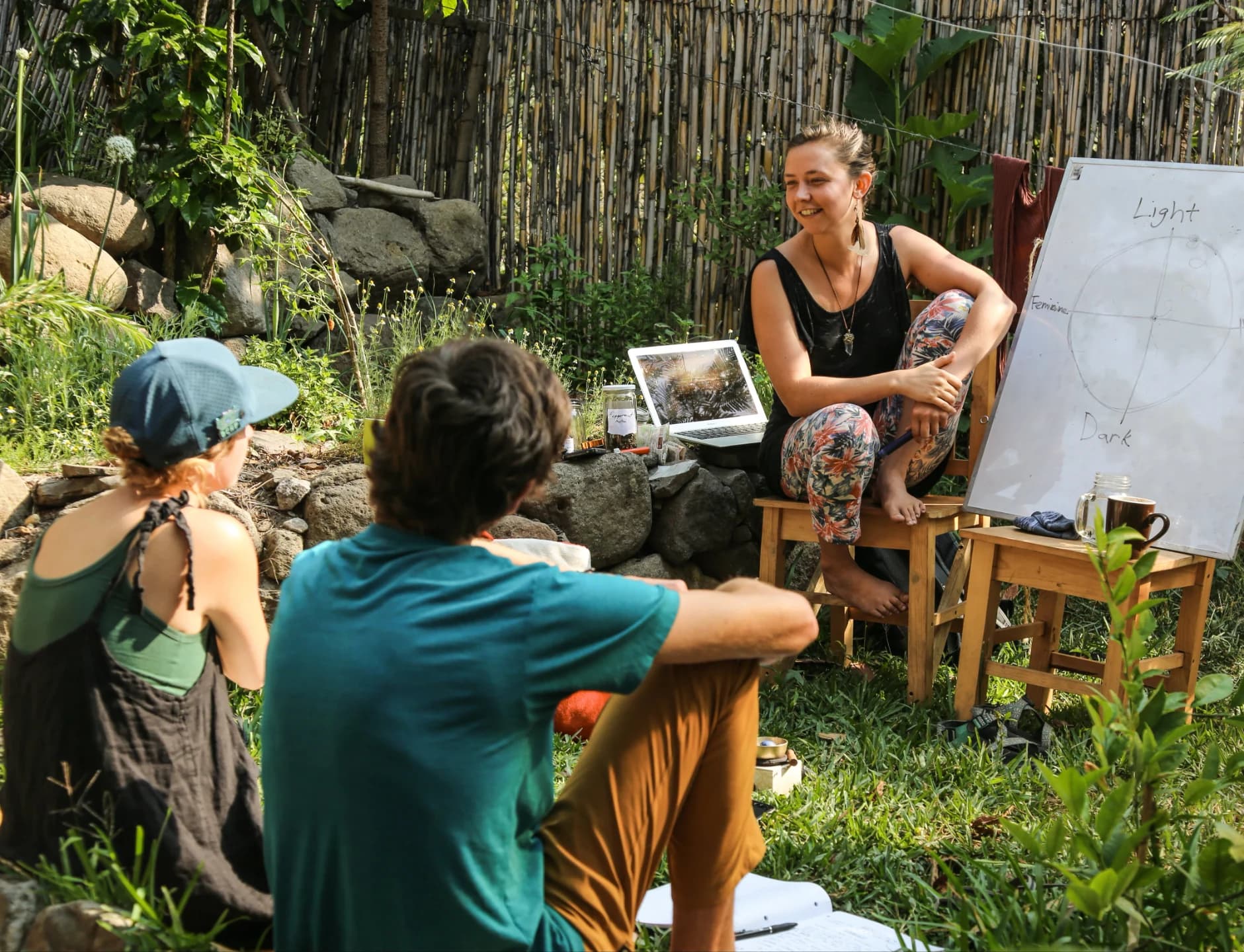
Why Permaculture?
Before a single seed goes in the ground, we zoom all the way out. Lesson one reframes permaculture as ecosystem design — then asks where it fits in the whole story of human culture, and why it might be the most hopeful work of our time.
- Permaculture Design Course
- Module 01 · Foundations
- ~90 minutes
- Free preview lesson
Permaculture is ecosystem design. Once you understand how a healthy ecosystem actually works, you can apply that same logic to designing almost anything — a farm, a watershed, an economy, a life.
One short detour before we get our hands dirty
A working definition, a map for thinking clearly, and the long story of how we got here — so the practical skills that follow land on solid ground.
A working definition
Permaculture is ecosystem design. Understand how a healthy ecosystem works and you can apply that same logic to almost anything.
The integral map
Ken Wilber's four quadrants — a simple tool for seeing any problem from every angle at once, inside and out, individual and collective.
The human journey
How food and technology quietly shaped culture — from hunter-gatherers to the rational age — and where we go next.
Ethics in practice
Earth care, people care, fair share — and the circular economy that turns those ethics into a living, waste-free system.
Everything is a whole — and a part of something bigger
Ken Wilber called these “holons”. An atom is whole in itself, and part of a molecule. A molecule is whole, and part of a cell. A cell is whole, and part of a body. There is no top and no bottom — and life keeps integrating each level to create something entirely new.
That is exactly how evolution works: it integrates and transcends. A healthy ecosystem does the same — which is why learning to read one teaches you to design almost anything.
From the smallest part…
…each one whole, each one nested in the next. Greater depth, spanning less of the universe.
Ken Wilber's four quadrants
Any “whole” can be seen four ways at once: from the inside or the outside, as an individual or as a collective. Miss a quadrant and you miss the problem.
The subjective
Your emotions, your meaning, your level of awareness. It has to be felt and interpreted, not measured.
The objective
Your body, your brain chemistry, your behaviour — everything about you that can be seen and measured.
The cultural
Shared stories, values and worldview — the culture you swim in, mostly invisible until you look for it.
The systems
Land, food production, technology, the economy. The measurable structures a society runs on.
Permaculture lives herePermaculture starts in the lower-right — land, food, systems. But change there ripples through every quadrant: better land grows better food, a better-fed brain thinks more clearly, and clearer people grow a healthier culture.
How food quietly shaped culture
Change what is in the lower-right — the tools, the food system — and you change the inner life and the culture too. Here is that story in four moves.
Hunter-Gatherers
- System
- Foraging, fire & cooked food
- Awareness
- Magical
- Culture
- Animist and often matrifocal, with a deep, present-moment connection to the living world. Strong bodies, short lives, oral stories.
Agriculturalists
- System
- The plough & stored grain
- Awareness
- Mythic
- Culture
- Surplus food brings kingdoms, writing, taxation and a shared mythology. Philosophy and art flower; lives lengthen as health slowly declines.
The Rational Age
- System
- Science, oil & the engine
- Awareness
- Rational — “Is it true?”
- Culture
- Questioning the old myths brings democracy, medicine, abolition and liberation — but we overdo it, and throw out the inner world entirely.
The Emergent Culture
- System
- Permaculture, renewables & circular economies
- Awareness
- Integral · non-dual
- Culture
- An emergent property we can create the conditions for, but never force — integrating every stage that came before instead of regressing to one.
Five levels of awareness
Every person climbs this ladder in a lifetime. A culture is simply the aggregate of the people in it — so where we each stand quietly pulls everyone around us up, or down.
Magic
Things simply happen, and that is wonderful.
Mythic
They happen because the story says so.
Rational
But is that story actually true?
Existential
And does any of it really matter?
Non-dual
Holding the contradictions, at peace with both.
“The idea is not to go back. The idea is to integrate.”
We are not trying to become hunter-gatherers again. We are trying to keep their connection to nature, the deeper truths inside the old myths, and every discovery the rational age won by asking “is it true?” — and weave them into something new. That includes making peace with our own capacity for harm, so we can give ourselves fully to its opposite: creation.
Necessary, but not sufficient
Permaculture is a land-management and design system that is necessary but not sufficient for our species to evolve. Without it over the next century, we are in real trouble. With it, we set the conditions for something better to grow — we just can't force it. Like a neocortex makes wisdom possible without guaranteeing it.
Three ethics to design by
Permaculture rests on three simple, foundational commitments — necessary ground rules for everything that follows.
Earth Care
Look after the soil, water, forests and the web of life we depend on.
People Care
Look after yourself and each other — meaningful work, real community.
Fair Share
Take what you need, return the surplus, and don't hoard.
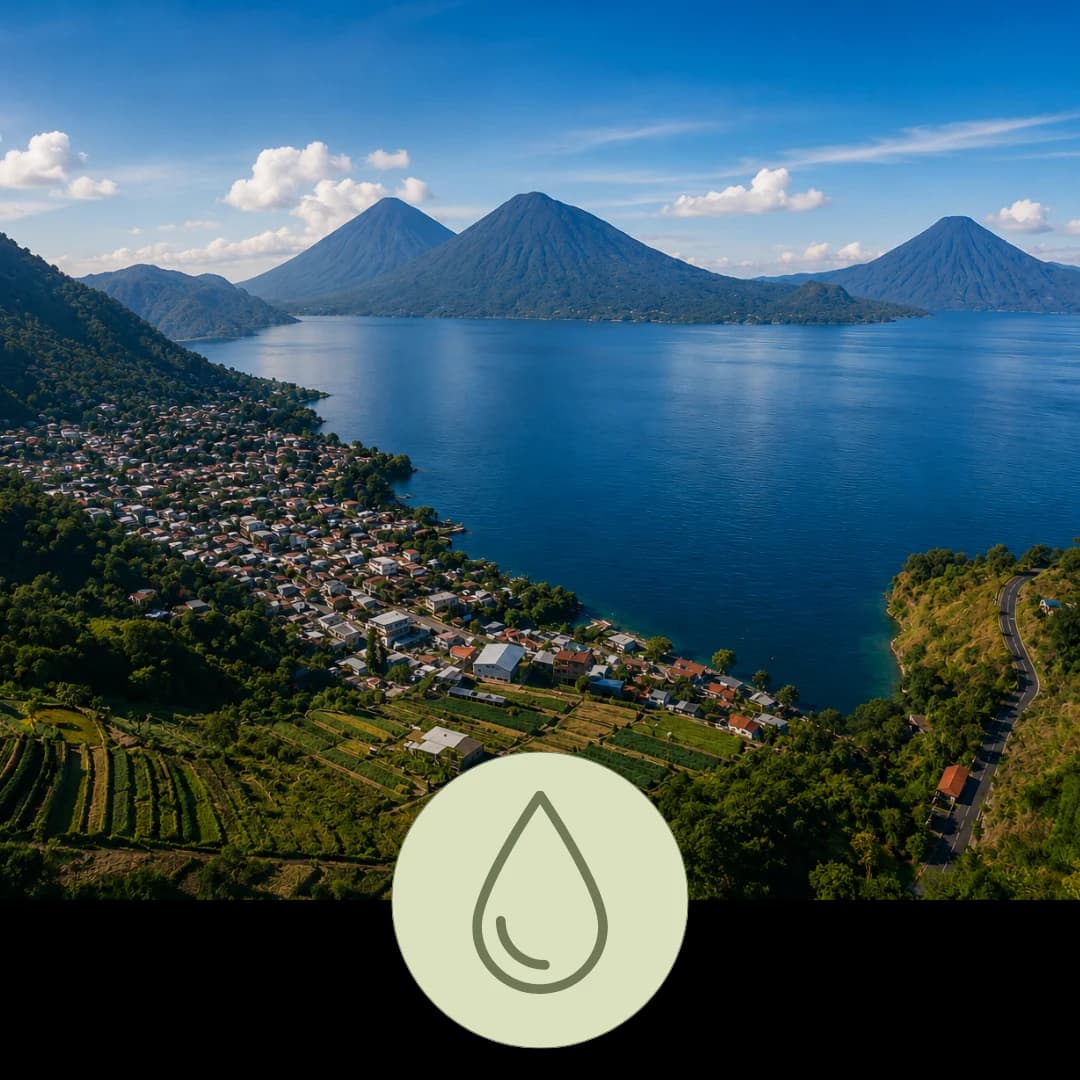
What a circular economy looks like
A real example from the farm. Grow the thing, add value where it grows, and let every output become the next input — so nothing leaches into the lake, and the wealth stays with the people who made it.
Grow clean coffee, locally
We buy from two or three nearby farmers who keep chemicals off their plants.
Process it on the farm
Instead of shipping it to a distant plant, the whole harvest is processed right where it grew.
Every output feeds the next
Pulp becomes worm compost. Wash water feeds the pond and garden. Husks are charred into biochar.
The value stays home
The money made on the cup stays in the community — so we can pay those farmers more.
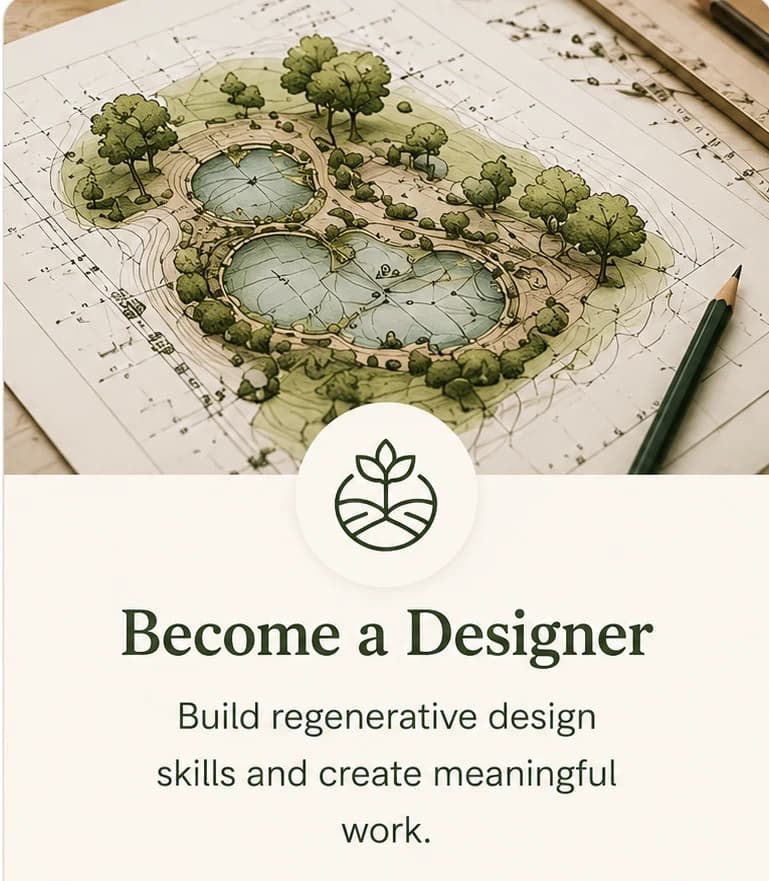
By the end of the course, you'll be able to…
The philosophy has a purpose: a complete, practical toolkit for becoming a beneficial force on the land.
- Turn any organic material into fertile, living soil
- Look at any plant and know how to make more of it
- Harvest water in many ways and sink it into your land
- Survey degraded land and design it into a thriving ecosystem
- See land as something humans can make more alive — not less
A landscape interacted with intelligently by human beings is more diverse, more productive and more alive than one left on its own.
Ready to design your regenerative future?
This was Lesson 01. The full Permaculture Design Course continues online and hands-on at Granja Tz'ikin, Lake Atitlán.